
Is it a mistake to start acne scars treatment in Korea while your jaw still breaks out, and the last laser you had at home left brown patches that took months to fade?
Often it is worth waiting. Scar treatment tends to go better once breakouts have been quiet for a while, any isotretinoin course is far enough behind you, and your skin isn't freshly tanned; started too early, the main risks are new inflammation and dark marks that can outlast the scars you came to treat.
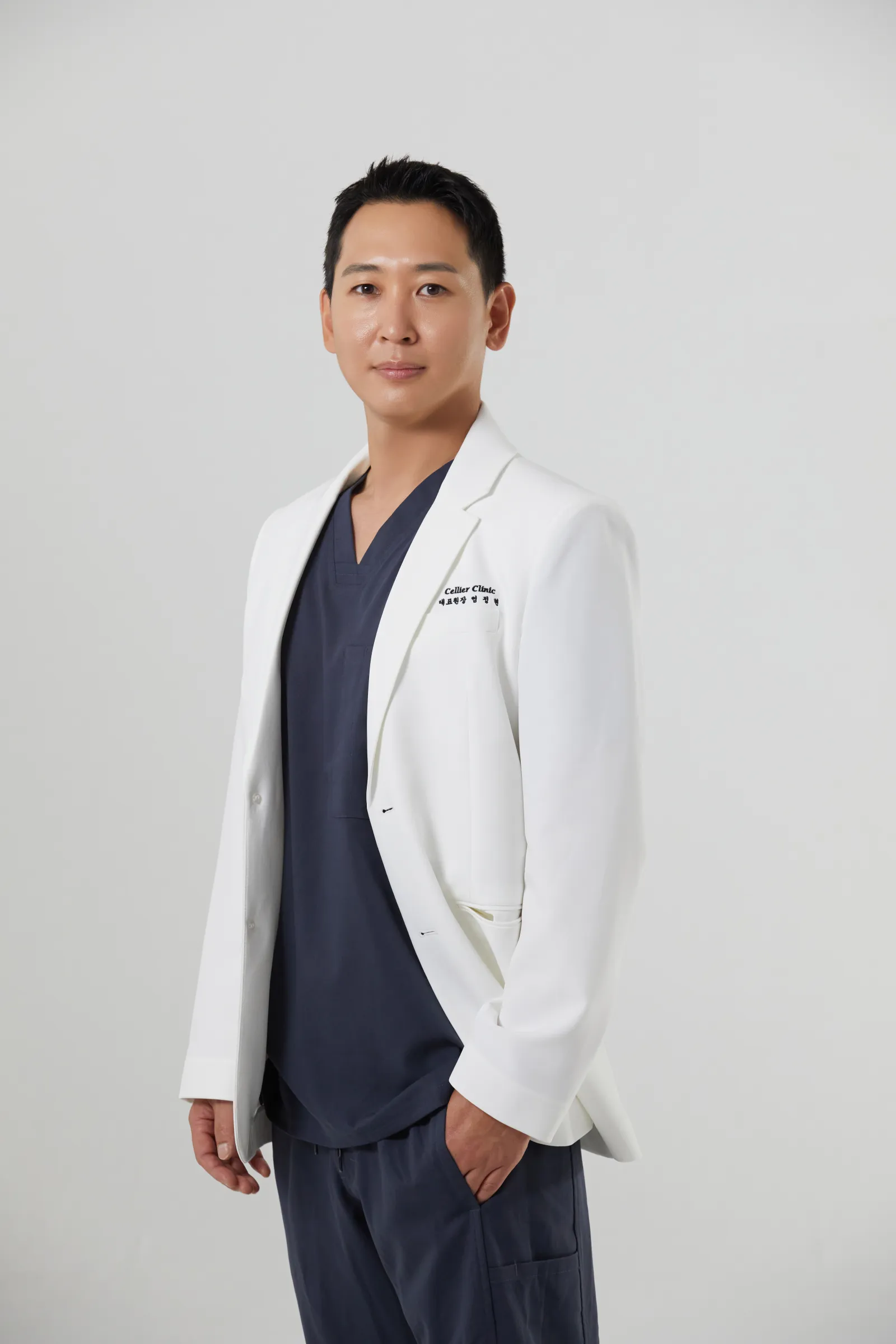
Hello, I'm Dr. Junghyun Youm, Director of Cellier Clinic in Gangnam, Seoul.
I'm a surgeon by training, and I see every patient one-on-one, so the doctor who examines your scars is the one you plan them with. That matters here because a dent in the cheek is rarely only a skin problem: skin, muscle, bone structure, fat and volume are assessed together, and rolling scars often sit where the tissue underneath has thinned.
If you're unsure whether your skin is calm enough to start, take two photos of each cheek beside a window with the light coming from the side, and send them on WhatsApp with your travel dates and the date of your last breakout or isotretinoin dose. Side light shows the edges of rolling and boxcar scars that a ceiling light flattens out, so the photo shows what you actually want to change.
Why not treat scars while you're still breaking out?
Treating scars over active acne is like repainting a wall while the pipe behind it still leaks. RF microneedling makes many fine channels in the skin and heats the layer beneath, which is how it prompts new collagen. Push those channels through an inflamed spot and you can spread the inflammation, and every new inflamed spot is a candidate for the next dark mark or the next scar.
So the first question is whether the acne is controlled, and only then which device. Controlled doesn't mean perfect skin. One or two small spots a month, away from the area being treated, is a different situation from cheeks that still erupt every week. If you're on a treatment for active acne at home, keep going with it; scar work comes after.
Isotretinoin needs its own sentence. The traditional advice was to wait about six months after the last dose before procedures that injure the skin. More recent reviews have relaxed that for gentler procedures, and doctors still differ, so bring the date you finished: it shapes what is reasonable on this trip.
What Korean skincare can and can't do for scars
Korean face washes, spot patches and acne serums are made for active breakouts and oil. They can help keep acne quiet, which is exactly the groundwork scar treatment needs. They don't lift a depressed scar. Once the collagen under a scar has been lost, or pulled down by bands of scar tissue, no cleanser reaches that layer.
Will acne scar treatment leave dark marks on medium or darker skin?
In short, it can, and if your skin tans easily or a previous laser left brown patches, it's the risk I'd weigh first. That darkening is postinflammatory hyperpigmentation: the skin answers heat or injury by making extra pigment. It isn't a burn and it usually fades, but on medium to deep skin tones it can take months.
How the energy is delivered matters. Treatments that strip the surface, such as ablative resurfacing lasers, carry a higher risk of this darkening on deeper skin tones. RF microneedling puts most of its heat below the surface through fine needles, which is why it's often considered for skin of color; the risk is lower, not absent.
Three things raise that risk on a trip: a fresh tan, a sunburn, and long days of sightseeing in strong sun right after treatment. If you're visiting in summer, put the session in a stretch of the trip with less time outdoors, and pack a hat and a broad-spectrum sunscreen your skin already tolerates. Skip the jjimjilbang saunas for the first few days too; heat and sweat on freshly treated skin is the wrong mix.
Say you're 31, with medium-tan skin, rolling scars across both cheeks, a few breakouts along the jaw each month, and ten nights in Seoul in August. If the cheeks themselves are clear and the jaw breakouts sit outside the area, a cautious first session on the cheeks early in the trip is a reasonable conversation. If the cheeks still erupt, I'd rather you settle the acne at home and come back for the scars; a darker patch over a scar is a worse souvenir than waiting a season.
As a surgeon, I think about scars the way I think about any healed wound: the tissue underneath decides what the surface can do. A rolling scar is often tied down by a band of scar tissue, with less volume beneath it, and energy alone may not free that band. A surgeon's understanding of facial structure informs each treatment plan here, which is why I'd rather tell you which part of a scar a treatment can't reach than promise you a smooth surface.
Risks and side effects to know: redness, flare-ups, cold sores and slow-fading marks
After RF microneedling, redness and mild swelling are expected, and many people see fine pinpoint marks or tiny scabs; these usually settle over a few days. Makeup, retinoids and acid products usually wait a few days as well. Bruising is more likely if you take blood thinners or supplements that thin the blood.
Less common are an acne flare in the treated area, infection, a cold-sore outbreak set off by the treatment, and the darkening described above. Rarely, texture changes or new scarring can follow, most often when skin is treated over infection or with settings too strong for it. Results and recovery differ from person to person, which is why suitability is set face to face.
Generally, these are reasons to wait or to skip it:
Active acne or any infection in the area to be treated
An isotretinoin course finished recently
A recent tan or sunburn, or a laser or peel in the past few weeks
A history of keloids or thick raised scars
Frequent cold sores (mention them in advance; a preventive prescription is your doctor's call)
Pregnancy or breastfeeding, or a pacemaker or other implanted electronic device, which generally rules out radiofrequency
If something shows up after you fly home, act on it early. A brown patch appearing over two to four weeks is usually postinflammatory darkening: keep up strict sun protection, don't pick or scrub, and have it checked rather than reaching for strong home peels.
If one of the points in that list applies to you, such as a keloid on your chest or an isotretinoin course you stopped in spring, put it in your first WhatsApp message. It's the detail that most changes what is sensible to do on this trip.
What Korean laser treatment for acne scars can't reach
Scar treatment softens scars; it doesn't erase them. The American Academy of Dermatology's patient guidance makes the same point, and the goal I'd set with you is softer edges and less shadow in daylight, usually across several sessions. Which scars respond depends on their shape, covered in more depth in our guide to knowing your acne scar type.
Rolling scars. What it is: Wide, soft dips, often tied down by scar bands; What tends to help: RF microneedling; deep ones may also need the band released or volume added.
Boxcar scars. What it is: Flat-bottomed dents with sharp edges; What tends to help: Shallow ones often soften with RF microneedling; deep ones respond less.
Icepick scars. What it is: Narrow, deep pits; What tends to help: Energy devices reach them poorly; targeted methods work better.
Red or brown marks. What it is: Flat color left by old spots, not dents; What tends to help: Lasers aimed at redness or pigment.
On our menu, Potenza is the treatment used for scars and pores: microneedles carry radiofrequency energy into the skin to encourage collagen and elastin. For flat marks, Clarity II is used for redness and PicoSure Pro for pigmentation. Subcision to cut scar bands, chemical reconstruction for icepick pits and ablative resurfacing lasers are not on our treatment menu. If your scars are mostly deep icepick pits, those are the methods to ask about, and a clinic that offers them may suit you better.
Where a rolling scar sits over lost volume, filler can lift the area from below, and it is on our menu. Before you add it, read about where filler goes and who should hold off, because placement matters more than the product name.
How many sessions, and does one trip cover them?
In short, that spacing is longer than most holidays, so one trip usually covers the first session rather than the whole plan.
Book the scar session in the first days of your stay, not the last, so an early flare or cold sore appears while you're still in Seoul. Some redness on the flight home is fine. We're open Monday to Friday 10 AM to 8 PM (lunch 2 to 3 PM) and Saturday 10 AM to 4 PM, closed Sundays and public holidays, with the last reservation an hour before closing. For fitting this into a longer itinerary, see how to plan skin treatments around a Seoul clinic visit.
What decides the cost of acne scar treatment in Seoul?
The figure for your scars moves with a handful of things:
How many sessions you plan, and how many fall on this trip
Whether only the dents are treated, or flat red and brown marks too, which means a second device
The area: both full cheeks, or a smaller patch such as the temples
Whether filler is added under deeper rolling scars
Numbing
Read any quote the way you'd count the threads in a thread lift quote: what it counts matters more than the total.
What should you ask any clinic before scar work?
Put simply, it doesn't have to be us. Wherever you book, these questions show quickly whether a plan fits your skin:
- Is the doctor who examines my scars the one who plans the treatment?
- What happens if my acne is still active on the day?
- Which of my scars will this reach, and which won't it?
- How are settings adjusted for skin that darkens easily?
- What should I do if a flare or infection appears after I fly home?
- Is an interpreter available, and is there a charge?
Where I stand on scars and timing
Scars are worth treating, on calm skin and at a pace the skin can absorb. Starting a season later costs you a few months; starting on inflamed cheeks can cost you the months it takes a dark patch to fade. This decision can wait until your skin is ready.
Cellier Clinic is on the 5th floor of Rex Tower, 108 Dosan-daero, Gangnam-gu, Seoul, about a 1-minute walk from Sinsa Station, Exits 1–2. In person, what decides your plan is whether your scars have sharp or rolling edges, how much volume sits beneath them, and how quiet your skin has been. Send your side-lit cheek photos on WhatsApp with your travel dates and ask whether your skin looks ready for a first session on this trip; we'll reply with how the consultation works.
— Dr. Junghyun Youm, Director
Sources
- American Academy of Dermatology — Acne scars: Diagnosis and treatment
- American Academy of Dermatology — Microneedling: Can it fade scars?
- DermNet — Postinflammatory hyperpigmentation